Diocesan News
The Australian Catholic Bishops’ recent Social Justice Statement, Living the Gospel in Times of Social Division, calls Catholics to reflect on how they live the values of the Gospel in a world often marked by division, disagreement and misunderstanding. Central to the statement is an invitation to foster what Pope Francis has described as a “culture of encounter” – a commitment to meeting others with openness, building relationships across differences, and working together for the common good.
Drawing on Pope Francis’ teachings in Laudato Si’ and Fratelli Tutti, a culture of encounter challenges people to seek genuine connection and dialogue. As Pope Francis explains, it is about “meeting others, seeking points of contact, building bridges” and creating processes that enable people to accept and navigate differences together.
Inspired by this vision and encouraged by the Social Justice Statement, Bishop Mark Freeman has begun a renewed process of engagement with local abuse survivor groups, including LOUD Fence and the Ballarat and District Survivors Group. The dialogue centres on the development of a Memorandum of Understanding that would support the establishment of permanent memorials to victims and survivors of abuse, as well as their families and supporters, at St Patrick’s Cathedral and St Alipius Parish in Ballarat East.
The initiative has its origins during the episcopacy of Bishop Paul Bird. While progress towards the memorials stalled for a number of reasons, Bishop Mark believes it is important to continue the work already undertaken and bring the project to fruition.
The Memorandum of Understanding outlines the formation of a working group comprising representatives from the survivor groups and the Diocese. Representatives from St Patrick’s Cathedral Parish and St Alipius Parish would participate on behalf of the diocesan community, working collaboratively to guide the project.
Bishop Mark acknowledged that meaningful collaboration often requires patience, generosity and a willingness to listen deeply, especially where there has been disagreement in the past.
“Any collaboration between groups demands a spirit of generosity and a readiness to give ground,” he said. “The Church community is called to humility in its encounters with abuse survivor groups. Attempts to control the agenda have contributed significantly to the difficulties the Church has experienced in responding appropriately to those who have suffered abuse at the hands of Church personnel.”
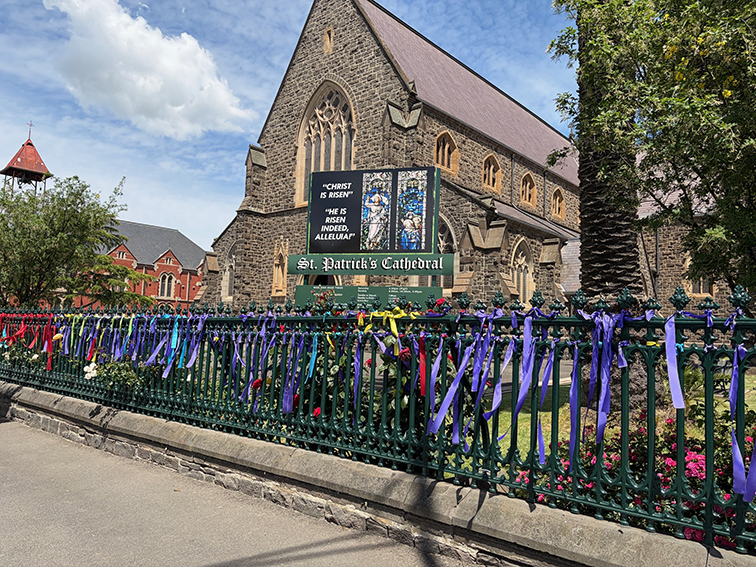
As part of this commitment to reconciliation and healing, Bishop Mark has invited Catholics across the Diocese to support and accompany victims, survivors and their families. He has also asked that ribbons tied to fences at the Cathedral, St Alipius and other sites around the Diocese by survivor groups not be removed.
“The ribbons are a visible reminder of those whose lives have been profoundly affected by abuse,” he said. “They also remind us of our commitment to safeguarding and ensuring that every child, young person and vulnerable adult is safe within the life of the Church.”
Bishop Mark said that genuine encounter, grounded in the example of Christ, leads to reconciliation, healing and peace. “When we are prepared to give of ourselves in the spirit of the Gospel, we can move towards healing together,” he said. “We owe it to our brothers and sisters in Ballarat and beyond to work together in a spirit of encounter.”
The initiative represents an important step in building relationships based on respect, listening and shared purpose, while honouring the experiences of survivors and strengthening the Diocese’s commitment to safeguarding and reconciliation.