

Diocesan News
 From Light to Bridge: Voices of Hope Resonate at the Mission: one heart many voices Conference
On Monday, May 19, the Mission: One Heart Many Voices (MOHMV) conference officially opened in Sydney.
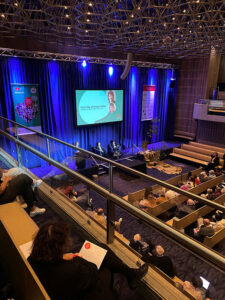
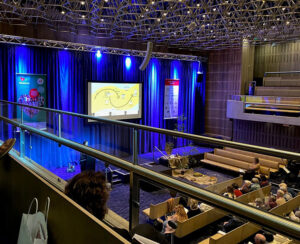
With over 300 participants gathering for the three-day event, the conference brought together people from across Australia and from diverse backgrounds.
The theme for the 2025 conference was: Choosing Hope. Trust yourself to its leading. This theme was chosen to connect with the Jubilee Year focus: Pilgrims of Hope.
The opening ceremony began with a powerful Welcome to Country led by Isaac Bamblett, a Bundjalung and Wiradjuri man. “It is important to be here and be spiritually connected. While it’s meaningful to do the Acknowledgment on video, it’s just as important to have someone physically come in and give a deeper spiritual and physical dimension to the moment,” shared Isaac.
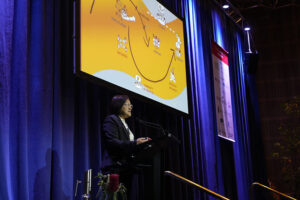 The morning continued with prayers and songs, setting the tone for the first keynote session, delivered by Estela Padilla, Theologian and Member of the Synod on Synodality. Her address titled, “Searching your hope, trusting to its leading – Why be a Pilgrim of Hope?” explored the spiritual and practical dimensions of hope.
Estela reflected on the synodal journey between local communities and the Universal Church and how hope emerges through personal, communal, and global experiences, describing hope as something that can take many forms including a rock and a bridge. “My first description of hope is light inside of you… this light go through your cracks of darkness, this light pushed me to breaking free,” said Estela.
Following this, Anna Cody, Australia’s Sex Discrimination Commissioner, addressed the theme of Choosing. She spoke candidly about the ongoing reality of sexual abuse in Australia, particularly among marginalised groups such as migrants and LGBTQI+ individuals, and emphasised how creating safe spaces for people in distress can spark real change and build a safer future for all.
In the afternoon, participants attended a range of workshops. These included reflections on applying synodal principles in local Church contexts, led by Kelly Paget, Head of Mission and Chancellor of the Diocese of Broken Bay, as well as sessions on incorporating Theory U and synodality into dialogues around First Nations representation in truth-telling, led by Jenny Collins-White, Associate Director of Mission Formation at Catholic Mission.
Throughout the day, attendees were invited into moments of quiet reflection and meaningful encounter, fostering deep, heartfelt connections at the centre of the MOHMV experience.
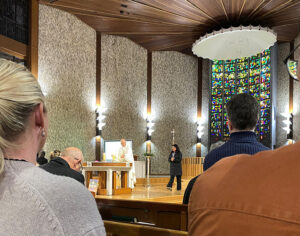
The Conference Mass was celebrated by Bishop Tim Norton at St Peter Julian Church.
 |
 |
 |
 |
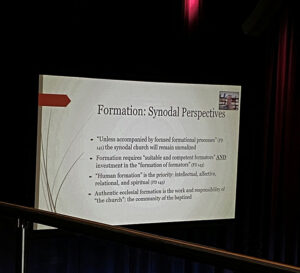
Tuesday included Richard Lennan speaking to, “Forming for hope: Possibilities in a Synodal Church” followed by quiet reflection, listening, sharing and Q&A.
Richard Lennan is a priest of the Diocese of Maitland-Newcastle, ordained in 1983. His graduate studies were at the University of Oxford and the University of Innsbruck (Austria); his dissertation was on Karl Rahner’s ecclesiology.
From 1992-2007, Richard taught at the Catholic Institute of Sydney, was a member of the Australian Anglican-Catholic dialogue and served as President of the Australian Catholic Theological Association (2005-07). Since 2007, Richard has taught in the United States and is currently Professor of Systematic Theology in the Clough School of Theology and Ministry at Boston College, where he also chairs the Ecclesiastical Faculty. Richard’s research and teaching focus on ecclesiology, ministry and the theology of Karl Rahner.
He has authored or edited ten books, the latest being “Tilling the Church: Theology for an Unfinished Project” (Liturgical Press, 2022) and, as co-editor, he has just completed “The Spiritual Theology of Karl Rahner.” Richard was a member of the theological panel for the Plenary Council of Australia (2021-22).
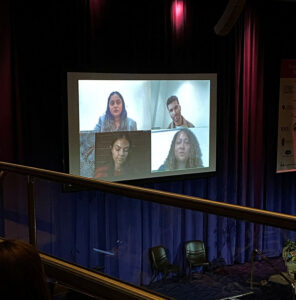
The second presentation included Madeline Forde in Conversation with Special Guests including Gerry from Melbourne, Zeb from Sydney and a friend from Cape Town talking about “What am I seeking? What is my quest?”, again followed by quiet reflection, listening, sharing and Q&A.
Maddy resides in Kaurna Country, working at Catholic Education SA as the Senior Advisor for Ministry, and is in the final stages of completing a Masters of Social Work. She has spent a decade advocating for and working alongside young people.
She is the current Oceania Representative for the International Youth Advisory Body in the Dicastery of Laity, Family and Life. Maddy is driven to redefine our perception of peripheries and people on the margins, challenging the discourse to instead recognise everyone is at the centre of their own worlds, so it our responsibility to sit with and amongst people.
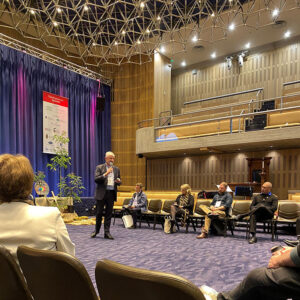
In the afternoon, participants again attended a range of workshops.
 |
 |
 |
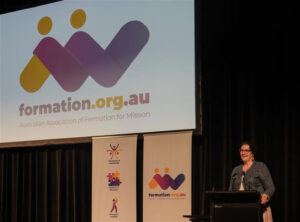
The final day of conference concluded with a surprise announcement: the launch of formation.org.au, a new professional association for those engaged in formation for mission.
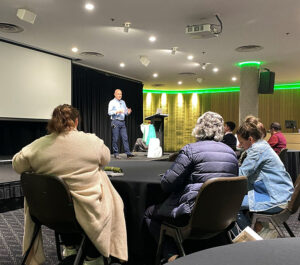
Lana Turvey-Collins, Lead Facilitator of the newly created association, introduced formation.org.au to over 200 attendees during the morning breakfast. She highlighted the benefits of this inclusive network, designed for anyone working in the space of formation for mission. “This is a space to ask big questions, to connect with peers and to broaden one’s horizons,” she shared.
“One of the aims of this association is to provide a platform where those involved in formation for mission can access relevant resources and nurture meaningful connections,” Lana explained. “Whether you bring deep experience and wisdom, or you’re just beginning your journey and looking for a mentor, there is a place for you here.”
The morning also featured the voices of past participants from Interfaith Encounters Program, a program initiated by Catholic Mission. Their reflections were powerful and inspiring, as they spoke about how the experience continues to shape them a year on. They shared how the program helped them build friendships and equipped them with the confidence to enter new spaces and ask bold questions.
“In a time of confusion and devastation, it’s easy to feel lost,” said one student. “But through the program, young people find hope, they are encouraged to go out, ask questions and come together.”
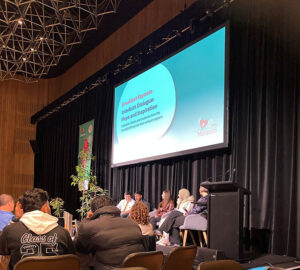
The morning continued with a panel discussion where conference attendees engaged openly, sharing their challenges, fears, insights, and, above all, their hopes for the future.
The day progressed with a final round of workshops, as attendees participated in the last moments of learning, dialogue, and connection.
As attendees departed, there was a visible glimmer of hope in their eyes. Echoing the words of Estela Padilla throughout the conference, this Jubilee Year is indeed a call to renewal. And while the conference came to an end, the fire ignited in the hearts of participants—the fire of hope—will continue to burn brightly as they return to their communities to carry forward the work of mission.
 |
 |
 |
Astrid Delayre
Communications Officer
with additions from Jane Collins